

COVID-19 changed the world. It’s probably not surprising. It was arguably the biggest and most global event of my lifetime, and these things tend to have long-term consequences. A worldwide pandemic causing tens of millions of deaths in a few short years tends to change how we see some things in our lives.
There’s no doubt that COVID-19 was, in 2020 and 2021, a massive problem. We have extremely robust data showing that the fatality rate from COVID-19 in the early days was incredibly high; studies showing how remarkably common it was for people to go to hospital with the disease prior to vaccination; and of course the proof of so many people who were killed by the infection in the first 24 months after it emerged.
But time has slowly worn on. The world has changed. It has now been more than four years since the start of the Omicron wave, and most people have largely forgotten about COVID-19. There’s the occasional news story, one or two people still monitoring the situation, but overall life has mostly just…moved on.
In my opinion that’s an entirely reasonable thing to do. COVID-19, since it emerged, has never been less of a problem than it is now. I don’t think people realize just how much the toll from COVID_19 has fallen in the last few years. So, inspired by an interesting thread on Bluesky by Professor Michael Fuhrer, I thought I’d write about it.
Looking Back
To get into the right frame of mind, we should go back to the heady days of 2022. In high-income countries, most people were vaccinated against the disease, and a reasonable chunk of the world had already had COVID-19 at least once. Nevertheless, there was a massive wave of infections caused by the Omicron strain of disease, which led to a very large number of deaths. Coming shortly after the big Delta wave, this was a very unsettling experience, but due to the high rates of population immunity—and particularly, all the vaccines—far fewer people died than expected.
2023 was the first year that you could say was “after” the pandemic. There were still a huge number of infections caused by SARS-CoV-2, but the lethality of the disease had plummeted and so even with quite a few people getting sick the negative outcomes—hospitalizations, deaths, Long COVID—were dramatically reduced. As I wrote at the time, COVID-19 was becoming a disease that public health experts tracked, rather than something we all had to care about in our everyday lives.
But what’s happened since then?
If you look at the data, every indicator that we have shows that COVID-19 has steadily become less and less severe every year since 2022. For example, deaths. Here are the recorded death rates for the country I live in, Australia, for each year since 2023 that have been caused by COVID-19:

In total, there were 3,804 deaths caused by COVID-19 in 2023, 3,473 in 2024, and just 1,613 in 2025. This is, of course, down from over 10,000 in 2022. It’s a massive drop.
We see the same drop in recorded cases. From the same report, here is the number of recorded COVID-19 cases in Australia since 2022:
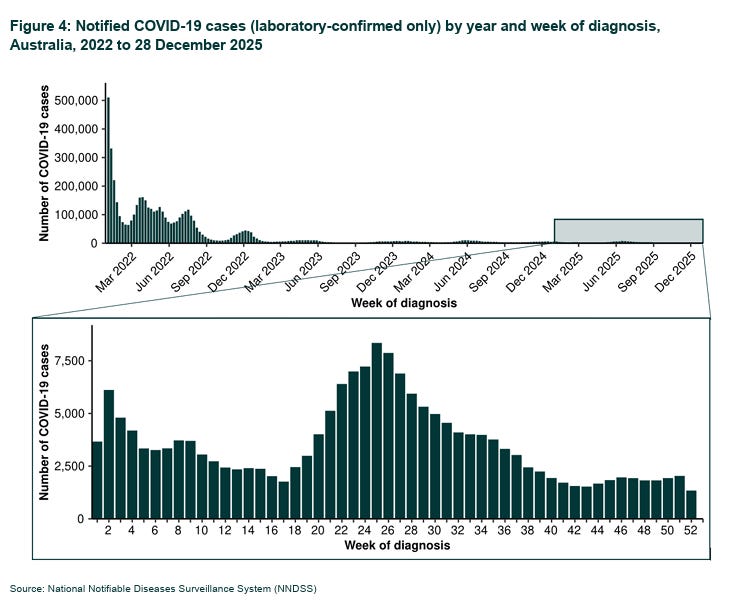
There is no doubt that COVID-19 numbers have fallen drastically. While it’s true that 2022 data is not easily comparable to following years—there were big changes to legislation and how RATs were recorded mid-2023 which means that the testing data changed significantly at that point—there has still been a huge drop even in the year-on-year COVID-19 infection numbers. In my state of New South Wales, there were 300k COVID-19 infections registered in 2023, and just 81k registered in 2025. While that is not an accurate count of infections per se, these numbers are comparable because they represent the same testing scheme in the same state. It’s quite likely that the actual number of infections has fallen by a factor of 3 or 4, which is a very large decrease given that the government has taken no action at all against COVID-19 in this time.
Indeed, we are now at a stage where COVID-19 is genuinely less problematic than influenza. People have been comparing COVID-19 to the flu since the very start of the pandemic. In 2020, it was an absurd comparison, with COVID-19 being somewhere around 10-20x more dangerous than influenza. However, things change. There were similar numbers of influenza and COVID-19 hospitalizations and deaths in Australia in 2025, and far more influenza infections overall. In my state of New South Wales, there were nearly 3x as many cases of influenza as COVID-19 in the last 12 months, which is genuinely quite remarkable. Perhaps more remarkable still is that these numbers continue to fall. If the trends persist, COVID-19 may be causing a somewhat negligible number of infections by the end of the decade.
These case numbers are, again, flawed, but since they represent identical testing schemes—people usually get one swab which tests for both influenza and COVID-19 at the same time—they are comparable. The exact number of cases is probably wrong, but we would expect the ratio of cases to be quite similar to the ratio of the true number of infections. So even if we’re underestimating the true number of infections by, say, a factor of 5, we would still expect to see that influenza caused 3x as many infections as COVID-19 in the last 12 months.
Even wastewater surveillance shows this. Australia didn’t start regularly reporting wastewater data until quite recently, but our neighbours in New Zealand did. Prof Fuhrer helpfully graphed these numbers, and they show that there is almost certainly less COVID-19 going around today than in years past.
We can’t completely rule out that one day there will be a huge resurgence of COVID-19. But this trend is, oddly enough, exactly what we expected. COVID-19 is quite similar to other human coronaviruses which mostly cause mild, seasonal colds. While it was very scary at the start, that was because we had no immunity to the disease, not due to some inherent quantity of the virus itself.
Yes, COVID-19 will probably be something that public health experts monitor as time goes on. We monitor a lot of things. But I think some good news is that it’s perfectly rational for the average person to treat COVID-19 in the same way they treat adenovirus, RSV, and influenza. You might not want to catch them, but most people probably don’t need to factor them into everyday life, either.
And what would you say to those of us that are daily struggling with the life changing effects of long COVID. And despite the lower risk of COVID what do we know about the risk of ending up with the life changing long COVID which can happen to those who are vaccinated as well as unvaccinated. I’m afraid you may be making too light of our situation.
What do you think of the studies showing persistent immune system damage from even a mild COVID infection? And of the studies showing cardiovascular and neurological damage? There really doesn't seem to be a lot of evidence in the scientific literature for the "COVID is no big deal" assertion - but a lot of evidence showing persistent health damage. I'd love to see some support for the "COVID is no big deal" assertion other than "Well, you won't die from it!"