
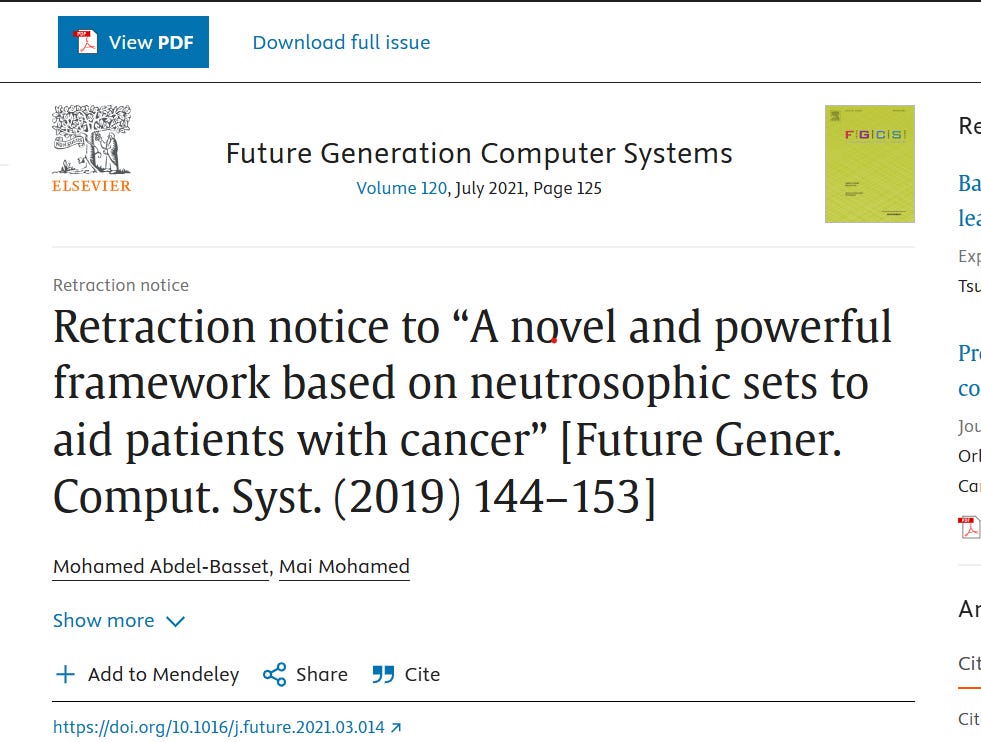
There is a lot of problematic research out there. I’ve written about this issue before—most people are not aware that there are real medical trials that doctors use to make decisions for our health which may never have happened at all. It’s a very sticky problem that is hard to fix.
The biggest hurdles when trying to correct the scientific record are simple: it’s hard to publish criticism in a meaningful way, and even when you do no one cares. I’ve published around a hundred Pubpeer—a public forum for post-publication review of academic work—comments so far. Many of those are for papers with very serious issues that are consistent with previous studies that have been retracted. Less than 10% of them have had any editorial action so far. Almost all of these are for studies that are directly impacting human health.
Two plucky young people are attempting to fix this issue. Matthew Jané and Kutenda Mvududu have set up Audit Clinical Evidence (ACE), a project looking to provide robust auditing of clinical studies to see which ones we can rely on and which ones are deeply flawed and should be discarded.
Their first project is a fascinating example of the problem. As I’ve been saying for a while, the literature around exercise as a way to treat depression is extremely problematic. Several of the most impactful studies in the area have serious issues that make them useless as evidence. Thus far, no one has listened, with new academic reviews coming out regularly arguing that exercise is incredibly effective as a treatment for depression.
Jané and Mvududu have first looked at a series of studies on exercise for depression. The story behind these trials is a particularly fascinating example of how even relatively minor studies can have a huge impact on patient care, especially if they have major issues.
Let’s look at the studies, their impact, and the importance of ACE.
The Studies
The problematic studies are a series of three randomized trials from a Saudi Arabian author looking at exercise for depression. The trials were all published in 2019, and found enormous benefits for exercise on traditional measures of depression severity. They all included similar populations and near-identical interventions.
In fact, the studies included precisely identical individuals and populations. The first part of the ACE audit of these studies demonstrates that in fact all three publications look at the exact same three groups of people. You can see this pretty easily when they are laid out side-by-side:
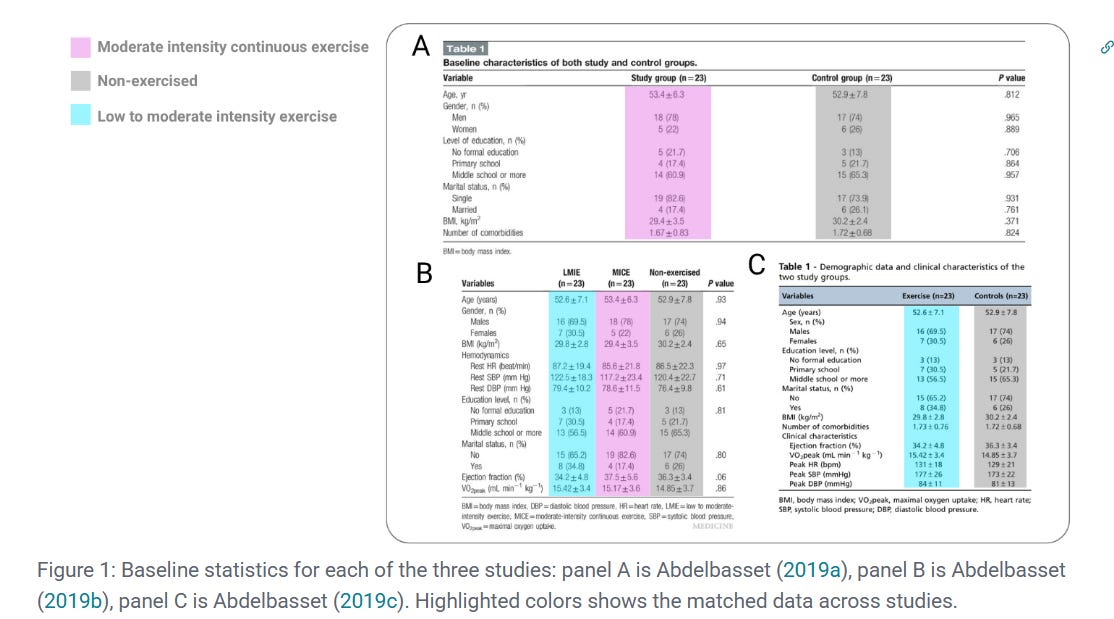
This is immediately very, very bad. It is a big academic no-no to publish the same results more than once without explicitly identifying the papers as duplicates. This is for several reasons, including one major issue that we’ll come back to later.
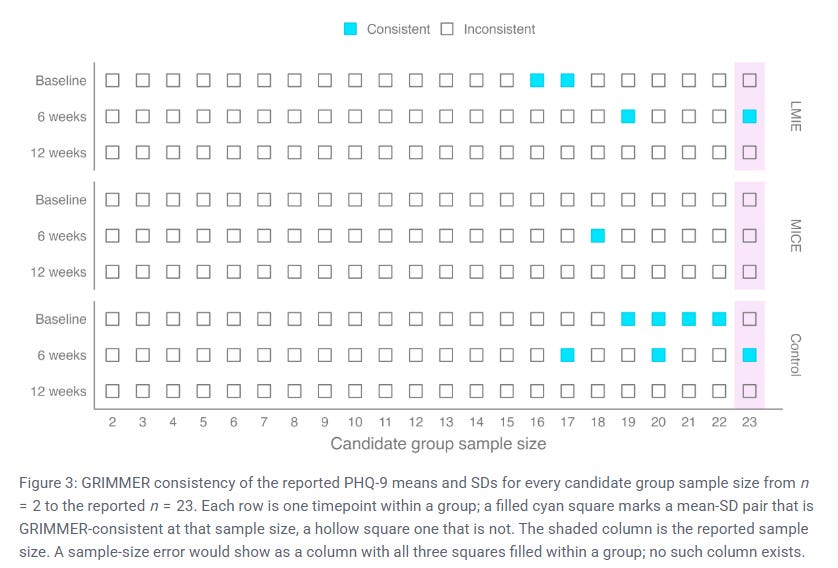
The papers also contain a range of mathematically impossible numbers in them. Jané and Mvududu used a technique called GRIMMER to test the mean values included in the papers. In simple terms, GRIMMER tests whether reported mean values and their associated standard deviations are possible given the stated sample size. An easy example of this is that if you’ve got two participants you cannot have a mean value of 3.33 for any outcome measured using whole numbers. That’s because every integer value divided by two will either have a .5 or .0 at the end of it.
GRIMMER expands on this to test the standard deviations—a measure of variance—as well. The ACE review found numerous GRIMMER errors in the papers, tested against every possible sample size. This means that the mean values for depression tests such as the Patient Health Questionnaire in the studies are not possible. Having impossible numbers in your trials is also not a great sign.
In addition, I noticed some mathematical errors in the papers that the ACE review did not include. If you look at the above tables, it’s clear that some of the p-values are wrong. Specifically, the p-values given in Table 1 A for categorical variables like gender cannot be correct because the authors have provided two p-values for the same analysis. If you try and re-run these tests using either the reported chi-squared analysis, Fisher’s exact test, or other forms of the chi-squared test you cannot replicate these p-values.
On top of this, the papers find a truly massive treatment effect. They found a standardized mean difference (Cohen’s d) of around 3 on the depression measurements that they looked at. To put this in context, the effect of Ozempic on body weight calculated from randomized trials sits at around a Cohen’s d of 1. The Cohen’s d measuring the average difference in height for adult men and women is around 1.6-1.7. I have never worked on a clinical trial that found an effect size that was above 1—it is technically possible to see a Cohen’s d of 3, but it would make this perhaps the most effective treatment ever come across in the history of medicine.
There are other issues with the papers. If you’re interested in the weeds, I strongly recommend checking out the full ACE report. We cannot say for sure if these trials happened or not, but we can say that no one should ever use them as evidence for medical treatments.
The Impact
The impact that these studies have had is a case study in how even relatively inconsequential problematic research can cause quite a lot of harm. In total, the three studies have been cited 74 times. That’s not nothing, but it’s not huge either—it’s not uncommon for randomized trials to attract over a hundred citations.
However, they have been cited by some key publications. In particular, all three studies have been included in systematic reviews, which are aggregations of research data intended to capture all existing studies on a question. Those systematic reviews have been cited over 800 times in total, and have made their way into 22 medical guideline documents.
Thee trials also have an outsized effect on the literature because they showed such extreme results. Remember, these trials found a massive improvement bigger than the effect of Ozempic for weight loss. This means that the reviews that included these trials have a far more rosy picture of exercise as a treatment for depression than is truly justified. And since the authors have published the same results three times—remember when I said that was an issue?—the trials have had triple the overall impact on the literature.
So even though the studies themselves are relatively obscure—I would be surprised if more than a couple hundred people had read any of them—their impact is quite large. There are almost certainly thousands of people worldwide whose psychiatric or psychological treatment has been in part based on these three papers.
What Can We Do?
There is no easy answer to issues like this. I have posted the concerns on Pubpeer, which is a platform for public post-publication review. Unfortunately, one of the concerns with the papers is that the lead author is an editor at the journal that published two of them, which makes complaining to the journal a lot more complicated.
I’m going to email the journals anyway. Maybe they’ll act. You could do the same—if enough people complain, there’s a real chance that something will happen.
You can also start following ACE on their website, and follow Jané on his Bluesky profile. There will undoubtedly be more of these investigations coming out soon.
Start a journal of public review? Need a war chest as seeing what happened to the data colada crew in terms of litigation.
Are you aware of the PACE Trial that’s still harming hundreds of thousands of ME/CFS sufferers because the authors and publishers refuse to retract it? I’m personally impacted and it seems there’s nothing that can usefully be done to overturn what’s influenced GPs and media to gaslight patients for over 10 years.
https://virology.ws/2025/10/25/trial-by-error-some-thoughts-on-ten-years-of-trial-by-error/