

The biggest story this week on social media has been about Last Ditch, the lesbian bar in Greenfield, Massachusetts. The story is worth reading, and was covered in depth by the Boston Globe, but in short:
The bar used to require mandatory KN-95 masks worn at all times.
This was unpopular. The queer bar that previously occupied the same tenancy drew large crowds, but Last Ditch struggled to get 10 people to attend even on a weekend night.
Due to this and other financial issues, the owners decided to make masks optional on Saturday nights as a way to boost attendance.
This turned into a huge firestorm where hundreds of people online heaped abuse on the bar and owner.
The whole story is remarkable. The fact that one of the owners stepped back from the bar to pursue education at a literal clown school is just one of the many comical facets of the narrative. It’s almost as fantastical as the latest Dungeon Crawler Carl book, although with less fire and mayhem (not none, but less).
Amid all of this, there’s a fascinating epidemiological question. Is there any good reason to wear a KN-95 mask to a bar at all? In my opinion, the answer is probably not except perhaps at the height of influenza season. Let’s take a look at the data.
The COVID-19 Pandemic
As most of you are probably aware, the COVID-19 pandemic emerged in late 2019 and rapidly spread across the globe. By the end of 2021, most of the world had either been infected or vaccinated against the disease, and by the end of 2022 most people had experienced both of those.
In the ensuing years - from 2023 until now - the pandemic has well and truly died down. Here’s a graph showing the decline recorded for people having COVID-19 on their death certificate (I used Claude to help tidy up the graphics and got the data from here):
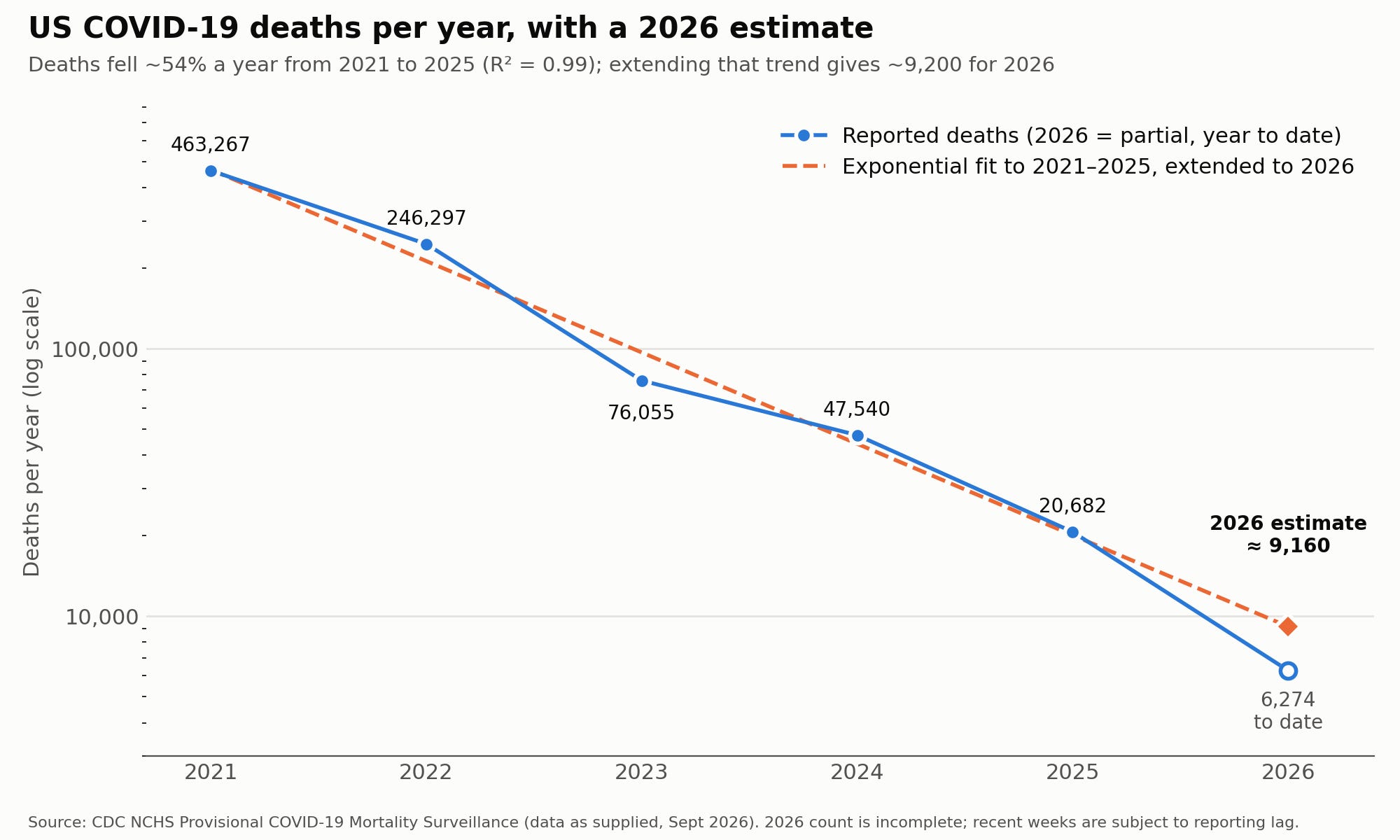
This is provisional data, and it’s possible that the 2026 death count will be a bit higher, but the estimate there uses an exponential function fit to the 2021-2025 trend and is likely to be pretty reliable.
This also hides some of the fall in COVID-19 deaths. In 2021, 90% of COVID-19 deaths had the virus listed as the primary underlying cause of death. In 2026, it’s only 67%. That means that the rate of people dying with rather than from COVID-19 has been growing, and the death count is now not as reliable an indicator.
There are other indicators that show a massive decline in COVID-19 risk. I wrote about some of these earlier in the year. Longitudinal wastewater collections show very low rates of viral activity, hospital systems report very few COVID-19 admissions—even excess mortality is now sometimes negative during COVID-19 surges as happened in my state of NSW this year.
Even Long COVID is declining rapidly. As Logging the World noted, the rate of people reporting long-term symptoms from COVID-19 has reduced by about 10% per year and is now at a historic low in the only longitudinal dataset I’m aware of that’s still collecting robust data. The specific figure is likely an overestimate for reasons I’ve talked about many times before, but the fact that even this estimate is falling is consistent with the idea that COVID-19 is rapidly disappearing as even a public health concern.
To put it simply: COVID-19 was an enormous problem in 2021, less of an issue in 2022, and is now genuinely not a particularly big worry. There are some people who have very severe issues after catching the virus, but that’s true of every virus. I think it’s entirely reasonable to say that COVID-19 is about as bad as your average seasonal virus in 2026, something that I could never imagine myself saying way back in 2020.
So why are people still wearing masks?
Risk Management
The discussion about COVID-19 prevention strategies tends to focus on two ideas:
People with disability are at an increased risk from the virus, and therefore we should all make significant efforts to avoid spreading it.
Long COVID is a major concern that we should all be worried about.
I’ve already touched on the second of these. Long COVID was certainly a major issue in 2020 and 2021, but in the ensuing years that’s become less and less true. I don’t think the risk of Long COVID is any greater than the risk that you might experience long-term symptoms from parainfluenza or adenovirus at this point, and it may well be lower.
The first point is in some ways more interesting. This is the concept that lead to the owners of Last Ditch bar being labelled eugenicists for relaxing their mask requirements one night a week. The idea is that having a disability so enormously increases your risk from COVID-19 that any situation where you don’t take every possible effort to prevent the spread of coronavirus is akin to actively wishing for the death of anyone who is disabled.
This is, and has always been, nonsense.
For one thing, “disability” is a very broad term. There is no good evidence that autism generally confers an increased risk from COVID-19. Conversely, people with severe and profound learning disabilities—for example Down syndrome and severe cerebral palsy—do face a substantially increased risk.
Similarly, disabilities such as blindness and deafness do not necessarily cause a person to face an increased risk from COVID-19. It’s possible, but the literature is a bit mixed. I also looked for a study which demonstrated an increased risk associated with wheelchair use for COVID-19 and could not find any. Disabilities are very different from one another when it comes to a whole range of health impacts.
The other major issue here is that for most disabilities or health issues even the risks that we have identified are fairly modest. Asthma is a great example. There’s a fairly obvious reason why asthma might cause an increased risk from a respiratory virus infection, and indeed it is associated with worse COVID-19. The increase in risk of severe disease, hospitalization, death, and long-term outcomes for people with asthma compared to those without is around 10%.
This is fairly common for disability-related risk factors for COVID-19. For example, the impact of haemophilia on COVID-19 outcomes is pretty modest. Mental health disorders are associated with an increase of around 40% for negative outcomes of COVID-19. Having cancer is only associated with an increase of somewhere in the range of 5-30% depending on study.
The biggest risk factor for COVID-19—both for severe acute outcomes and for Long COVID—is and has always been age. We showed this in 2020, and it’s been proven time and time again since. Every decade of age increases your risk from COVID-19 by more than double, meaning that a 25 year old amputee with haemophilia, POTS, and vision issues is on average likely at a lower risk from COVID-19 infection than a generally healthy 40 year old who does not have any disabilities.
There are a few conditions that do significantly increase your risk from COVID-19—and indeed any infectious disease. There’s strong evidence that severe immunodeficiency such as Kabuki’s syndrome or CTLA-4haplo insufficiency cause substantial increases in COVID-19 risk. This is completely unsurprising, as having a seriously damaged immune system is bad for your outcomes from any infectious disease.
Similarly, people who’ve previously had organ transplants are at a much higher risk from COVID-19 than those who haven’t. Again, unsurprising. If you’ve had an organ transplant you are usually on immune suppressing medication for the rest of your life.
But for the vast majority of people—even people with a disability—the risk from COVID-19 has mostly been about age. Yes, you are slightly more likely to have a severe infection if you have asthma, but it’s not a massive increase. At worst, we’re talking about a modest bump in risk of both acute and long-term outcomes—including Long COVID—for the vast majority of people.
It’s also worth reiterating that COVID-19 isn’t special in this regard. If you’ve had an organ transplant, you generally want to avoid any infections. COVID-19 is just one of many things that could ruin your week.
It was never true that exposing disabled people to COVID-19 amounted to eugenics. It’s absolutely wild to suggest now—in 2026 when the risk posed by COVID-19 is very low—that not wearing a mask around people with a disability is some sort of nefarious act.
Bottom Line
As an epidemiologist who has spent six years working on COVID-19, reading the research, and being generally very interested in the science of the disease, there are some times when I wear a mask. If I’m sick and outside my house, I put one on. If I’m walking around a high-risk area like an oncology ward. Occasionally I’ll wear one during the height of flu season, because I don’t want to bring unnecessary diseases home if I can avoid it—your risk of any respiratory infection in winter is MUCH higher than in summer.
I also think that there are places where we could reasonably require people to wear KN-95 masks. Dialysis treatment centres, for example, are places where pretty much all of the patients fit the definition of a high-risk person not just from COVID-19 but from lots of other diseases. Aged care facilities. Dementia wards. That sort of very high-risk space.
It’s probably also not a terrible idea for some individuals who are at very severe risks from any infectious disease to wear KN-95s out and about. If you’ve got a severe genetic immunodeficiency, you want to avoid pretty much every disease around.
But as a rule, I don’t think that there’s any incentive these days for general mask rules. I understand that Last Ditch was trying to make a statement, but from a scientific perspective I think it was a bit of a waste of time. In my opinion there’s no good reason for young people going out to drink and make merry to worry about masking or indeed about COVID-19.
This is incredibly helpful. It's especially meaningful given that you have been very clearly NOT a Covid denier at any point and very much recognized the risks early on.
thank you for writing about this, the discourse has been heated